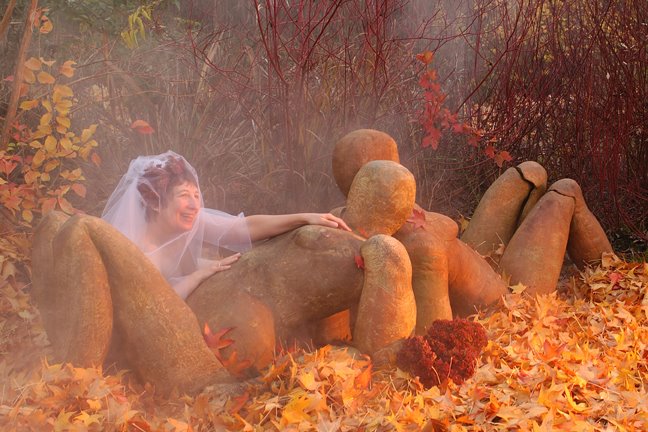
I’m thrilled to announce that my essay True Nature has just been published in Women Reinvented: True Stories of Empowerment and Change. It will officially be available in bookstores in July, but Amazon already has it!
I felt moved to tears by these honest personal stories told by women of many ages and diverse cultures, each facing a tough situation and moving through it into renewal. It’s a great book to read if you’re going through a transition (and who isn’t?), or to give to a friend facing a challenging change.
The profits from the sale of the book are donated to The Healing Project, which you can read about at www.TheHealingProject.org.
Tuesday, June 1, 2010


Monday, February 15, 2010
The Blooper Panel at the Yard Garden & Patio Show
The room was packed to overflowing with gardeners eager to hear all about our mistakes. Unlike the usual Yard Garden & Patio Show seminars, with glorious slide shows that inspire and educate the audience, our Blooper Panel of three garden columnists—Dulcy Mahar, Robb Rosser and myself—was a series of true confessions. Each of us told about our worst downfalls in the garden. Our misadventures along the perilous journey down the garden path were abundant.
Many of our first attempts were total disasters. Dulcy confessed that when she first began gardening, her flower borders “looked like two graves. Nobody told me about adding compost, and the plants did not prosper.” Later she learned about Kosher’s compost.
“It wasn’t blessed by rabbis—the gentleman’s name is Kosher,” she added. Soon the plants grew robust and all was well. Until she discovered that an entire bed of perennials was too flat. A trip to England shed light on that problem. She observed that borders included trees and shrubs, and she went home and inserted them into her borders. “Now there’s too much foliage and I need more perennials,” she added. It’s always something.
Dulcy’s first pond is legendary, the topic of many of her columns. The first pond was constructed in shade
“I’d forgotten that leaves fall off of trees into ponds,” she reminisced. Not only that, but since Dulcy, her husband Ted, and her three dogs all had short legs, she made the pond shallow to prevent drowning.
“But raccoons can wade. They decimated the pond liner,” she said.
Robb recounted his disaster with Coast of Maine fish fertilizer that he sprayed on the roses right before an open garden.
It can’t be that bad, he thought. But it was.
“It was ripe and pungent, like a salmon baking in the hot sun. People went up to sniff the roses and went, ‘Oh, my!’”
Gifts from well-meaning friends can become a gardener’s nightmare, like the two alpine goats, Harley and Davidson, that friends gave Robb for his birthday.
“Harley was the first animal I gave the heimlich maneuver to—he was a pig,” Robb recounted. Before the goats devoured his entire garden, he found a home for them with two teenagers. But the heartwarming moment was when he heard the goats crying out to him from the back of the truck, “Ddddddad!”
I received a gift of a dozen old rose bushes from an elderly woman who was dismantling her garden. Thrilled to get free scented roses, like ‘Madame Hardy’ I planted them enthusiastically in a big bed along the driveway, without a clue about how big they would get. Years later I fought my way inside the bed to dig out a five-foot-tall weed that had risen through the jungle of rose canes. Even with long sleeves, I could hardly get inside the thorny thicket, and nearly got stuck inside.
After a hard look at the situation, I hired a landscaper to dig out the roses, and brought in a truckload of composted manure. I planted my first low-maintenance border, layering Idesia trees, shrubs like Viburnum and Osmanthus, and drifts of hellebores, ferns and epimediums. It’s now my favorite bed in the garden.
Not to worry. Mistakes are great, they’re how we learn. It takes guts to risk failure. Gardeners are a brave and courageous tribe who keep on blundering, learning and laughing. If anything, we’re gardening more passionately than ever, possibly with a smidgeon more wisdom, but definitely with lots of gusto. Resisting is out of the question.
Dulcy’s final words of advice were “Don’t overly follow the rules,” and “Don’t be afraid to get just one of a kind (instead of groups of 3 or 5).”
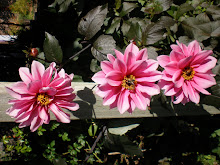
She says she will continue to be “over the top.” Me too. A huge order of dahlias is coming soon. Smitten by the dahlias blooming in Swan Island’s fields last summer, I ordered dozens to take advantage of free shipping and bonus plants. Where the heck will I plant them?
But as Dulcy put it so well, about her decision to give up growing roses, and then ordering more (but only very disease resistant varieties), “I can’t help myself.”
Many of our first attempts were total disasters. Dulcy confessed that when she first began gardening, her flower borders “looked like two graves. Nobody told me about adding compost, and the plants did not prosper.” Later she learned about Kosher’s compost.
“It wasn’t blessed by rabbis—the gentleman’s name is Kosher,” she added. Soon the plants grew robust and all was well. Until she discovered that an entire bed of perennials was too flat. A trip to England shed light on that problem. She observed that borders included trees and shrubs, and she went home and inserted them into her borders. “Now there’s too much foliage and I need more perennials,” she added. It’s always something.
Dulcy’s first pond is legendary, the topic of many of her columns. The first pond was constructed in shade
“I’d forgotten that leaves fall off of trees into ponds,” she reminisced. Not only that, but since Dulcy, her husband Ted, and her three dogs all had short legs, she made the pond shallow to prevent drowning.
“But raccoons can wade. They decimated the pond liner,” she said.
Robb recounted his disaster with Coast of Maine fish fertilizer that he sprayed on the roses right before an open garden.
It can’t be that bad, he thought. But it was.
“It was ripe and pungent, like a salmon baking in the hot sun. People went up to sniff the roses and went, ‘Oh, my!’”
Gifts from well-meaning friends can become a gardener’s nightmare, like the two alpine goats, Harley and Davidson, that friends gave Robb for his birthday.
“Harley was the first animal I gave the heimlich maneuver to—he was a pig,” Robb recounted. Before the goats devoured his entire garden, he found a home for them with two teenagers. But the heartwarming moment was when he heard the goats crying out to him from the back of the truck, “Ddddddad!”
I received a gift of a dozen old rose bushes from an elderly woman who was dismantling her garden. Thrilled to get free scented roses, like ‘Madame Hardy’ I planted them enthusiastically in a big bed along the driveway, without a clue about how big they would get. Years later I fought my way inside the bed to dig out a five-foot-tall weed that had risen through the jungle of rose canes. Even with long sleeves, I could hardly get inside the thorny thicket, and nearly got stuck inside.
After a hard look at the situation, I hired a landscaper to dig out the roses, and brought in a truckload of composted manure. I planted my first low-maintenance border, layering Idesia trees, shrubs like Viburnum and Osmanthus, and drifts of hellebores, ferns and epimediums. It’s now my favorite bed in the garden.
Not to worry. Mistakes are great, they’re how we learn. It takes guts to risk failure. Gardeners are a brave and courageous tribe who keep on blundering, learning and laughing. If anything, we’re gardening more passionately than ever, possibly with a smidgeon more wisdom, but definitely with lots of gusto. Resisting is out of the question.
Dulcy’s final words of advice were “Don’t overly follow the rules,” and “Don’t be afraid to get just one of a kind (instead of groups of 3 or 5).”
She says she will continue to be “over the top.” Me too. A huge order of dahlias is coming soon. Smitten by the dahlias blooming in Swan Island’s fields last summer, I ordered dozens to take advantage of free shipping and bonus plants. Where the heck will I plant them?
But as Dulcy put it so well, about her decision to give up growing roses, and then ordering more (but only very disease resistant varieties), “I can’t help myself.”
Monday, March 23, 2009
The Garden Saved My Life
What I enjoy writing about most of all is what happens to us when we garden—how gardening changes us, shapes us, teaches us, gives us gifts we could never have imagined. In “Garden Retreats” I wrote about creating an outdoor sanctuary; in “Married to My Garden” I wrote about my love affair with gardening; and in “Garden Muse,” my weekly column for the Portland Tribune, I often reflect on how the garden is a source of great joy and inspiration.
So I’m thrilled that my personal essay, “The Garden Saved My Life” was just published in a new anthology, “The Ultimate Gardener,” in the section aptly titled Garden Transformations. For it’s the transformative aspect of gardening that I’m especially interested in these days—how the garden heals us, comforts us, and takes us out of our small everyday selves into the bigger soulful part of our nature.
The stories inside The Ultimate Gardener will inspire you, make you laugh and cry, and bring you new ideas about gardening. You can order the book on line and find it in many bookstores. I’ll be signing personalized copies at upcoming events this spring and summer. If you’d like to receive notices about dates and places, just let me know and I’ll e-mail you directly. The book makes a perfect Mother’s Day, Father’s Day, Birthday or Anniversary present.
So I’m thrilled that my personal essay, “The Garden Saved My Life” was just published in a new anthology, “The Ultimate Gardener,” in the section aptly titled Garden Transformations. For it’s the transformative aspect of gardening that I’m especially interested in these days—how the garden heals us, comforts us, and takes us out of our small everyday selves into the bigger soulful part of our nature.
The stories inside The Ultimate Gardener will inspire you, make you laugh and cry, and bring you new ideas about gardening. You can order the book on line and find it in many bookstores. I’ll be signing personalized copies at upcoming events this spring and summer. If you’d like to receive notices about dates and places, just let me know and I’ll e-mail you directly. The book makes a perfect Mother’s Day, Father’s Day, Birthday or Anniversary present.
Monday, March 9, 2009
Kiss the Ground
I just returned from a visit to the east coast and now I want to kneel down and kiss the ground here. First of all, our gardens are green with grass and OK, maybe weeds too, but still green is everywhere—Doug Fir, pines, spruce, hemlock, Japanese incense cedar, eucalyptus, evergreen viburnums, daphne, sweet box, boxwood, box honeysuckle, Senecio greyii, Phlomis fruticosa. The lawns on the east coast are brown, and yes, there are evergreens, but nowhere near the variety that we can grow.
Hellebores are blooming here and we take them for granted every winter, along with snowdrops, lungwort (Pulmonaria), early daffodils, witch hazel (Hamamelis), winter hazel (Corylopsis) and winter aconites (Eranthis). We can actually design a garden with winter as the backbone, an easy way to guarantee happiness in the quiet season. Make sure to include a witch hazel or ‘Dawn’ viburnum for flowers and scent; sweet box (Sarcococca) for fragrant evergreen understory in the shade; Mahonia x Charity for yellow flowers that draw the earliest hummingbirds; and winter cyclamen for a splash of hot pink flowers and marbled leaves.
It may hail and snow in March, but the robins are still out there singing their hearts out and searching for worms. Rose canes are breaking new growth and every day I go out and prune a few of the dozens and dozens that wait patiently for their annual haircut. This is the time to spot the early weedy grasses and dig them out while the ground is soft, to find the baby cresses and yank them before they bloom and go to seed, to detect the buttercups sneaking in between the irises and geraniums and trowel them out. So don’t be a sissy. Throw on some hooded fleece and get out in the garden. Sooner is better to get going on the spring garden and greet your plant friends as they emerge from winter dormancy.
Hellebores are blooming here and we take them for granted every winter, along with snowdrops, lungwort (Pulmonaria), early daffodils, witch hazel (Hamamelis), winter hazel (Corylopsis) and winter aconites (Eranthis). We can actually design a garden with winter as the backbone, an easy way to guarantee happiness in the quiet season. Make sure to include a witch hazel or ‘Dawn’ viburnum for flowers and scent; sweet box (Sarcococca) for fragrant evergreen understory in the shade; Mahonia x Charity for yellow flowers that draw the earliest hummingbirds; and winter cyclamen for a splash of hot pink flowers and marbled leaves.
It may hail and snow in March, but the robins are still out there singing their hearts out and searching for worms. Rose canes are breaking new growth and every day I go out and prune a few of the dozens and dozens that wait patiently for their annual haircut. This is the time to spot the early weedy grasses and dig them out while the ground is soft, to find the baby cresses and yank them before they bloom and go to seed, to detect the buttercups sneaking in between the irises and geraniums and trowel them out. So don’t be a sissy. Throw on some hooded fleece and get out in the garden. Sooner is better to get going on the spring garden and greet your plant friends as they emerge from winter dormancy.
Monday, February 16, 2009
Early Cuties
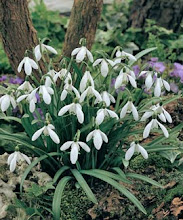
There’s something so endearing about the earliest flowers. Yesterday out in my garden, while I was kneeling down to clean up some leaf litter, I came across a little clump of snowdrops that had seeded themselves into the gravel near the greenhouse. Nose to nose with their tiny white flowers marked with green, a thrill coursed through me. Life is back in the garden!
Then I got an e-mail from my friend Michele who wrote, “The snowdrops in my front garden are tugging at my heartstrings.” All over Portland, no doubt, gardeners are exulting in the first flowers.
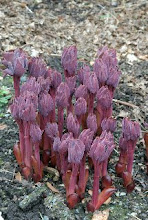
It’s the same when red peony shoots push through the soil and announce that they’re back for another season of sumptuous flowering. Even those first stems hinting at what’s coming in another few months is enough to make our hearts beat faster. It’s the eternal Yes! that we want to hear whispered, over and over, telling us that the plants lying dormant beneath the earth have only been waiting to reappear and delight us with their marvelous colors and scents.
Then I got an e-mail from my friend Michele who wrote, “The snowdrops in my front garden are tugging at my heartstrings.” All over Portland, no doubt, gardeners are exulting in the first flowers.
It’s the same when red peony shoots push through the soil and announce that they’re back for another season of sumptuous flowering. Even those first stems hinting at what’s coming in another few months is enough to make our hearts beat faster. It’s the eternal Yes! that we want to hear whispered, over and over, telling us that the plants lying dormant beneath the earth have only been waiting to reappear and delight us with their marvelous colors and scents.
Friday, February 6, 2009
The Thrill of False Spring
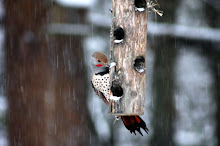
It's early February and these last two days have been our "false spring" with temperatures in the 60s, sunny and glorious. I'm in heaven. I know it will rain again, but not yet! Birds are very active too, exulting in the warmth, and the suet feeder is covered with little bush tits every day.
Cutting off last year’s hellebore leaves is so satisfying—while I’m doing this I’m face to face with the newly opening flowers. I tip the pendant blossoms upward with one finger and look right inside them—some white, some pink, some burgundy, some freckled with darker splashes of color. So many hundreds of tiny hellebore seedlings sprout at the feet of the mother plants, it’s hard to find safe places to tread.
Now is the time to cut back the big stands of ornamental switch grasses too—Panicum ‘Shenandoah’ and ‘Dallas Blues.’ I whack them back with long-handled loppers and pitch the spent tan stalks onto a big tarp, to be dragged to the compost pile. In my mind’s eye I see them rising up again, ‘Shenandoah’ with red tinted slender blades and ‘Dallas Blues’ with broader blue-green foliage.
Sedums too are ready to cut back, ‘Matrona’ and ‘Vera Jameson’ are already pushing up little succulent rosettes. I snip off the old stems and marvel at the signs of new life already arising in February. Everywhere I look the garden’s pulse is quickening.
Cutting off last year’s hellebore leaves is so satisfying—while I’m doing this I’m face to face with the newly opening flowers. I tip the pendant blossoms upward with one finger and look right inside them—some white, some pink, some burgundy, some freckled with darker splashes of color. So many hundreds of tiny hellebore seedlings sprout at the feet of the mother plants, it’s hard to find safe places to tread.
Now is the time to cut back the big stands of ornamental switch grasses too—Panicum ‘Shenandoah’ and ‘Dallas Blues.’ I whack them back with long-handled loppers and pitch the spent tan stalks onto a big tarp, to be dragged to the compost pile. In my mind’s eye I see them rising up again, ‘Shenandoah’ with red tinted slender blades and ‘Dallas Blues’ with broader blue-green foliage.
Sedums too are ready to cut back, ‘Matrona’ and ‘Vera Jameson’ are already pushing up little succulent rosettes. I snip off the old stems and marvel at the signs of new life already arising in February. Everywhere I look the garden’s pulse is quickening.
Monday, January 19, 2009
Why I Garden
For me, the garden is the best home I’ve ever made for myself. It’s where I relish the refreshing scent of rosemary and the smoky tints of ‘Hot Cocoa’ roses, that remind me of taffeta skirts. I love to listen to the bush tits whistle, to the chickadees and song sparrows belting out their arias.
Maybe because I grew up in a home where cleaning and cooking were accompanied by heavy sighs, I never took pleasure in housework. But out in the garden, most every job, except for mowing, is fun for me. My first garden teacher, Frank Curtis, radiated so much love for gardening that I caught the bug. He did everything with tender loving care, from settling his baby tomato plants into the soil, to nipping out the suckers, from building a compost pile to turning the soil. He taught me everything he knew—how and when to sow seeds, how to wield a mattock, which plants were weeds—with so much joy! His enthusiasm was contagious.
From the beginning, gardening connected me with a big world of emerging life—woody stems swelling with buds, tiny hellebore seedlings sprouting beneath the mother plants, iridescent black beetles climbing out from a pile of damp leaves. Sometimes I even stop to marvel at the persistence of weeds, at the temerity of slugs and aphids.
If I help out, the wetland I live on becomes a better garden. The native clay soil, for example, is a perfect medium for growing plants—once I amend it with pumice or crushed rock for better drainage, and with compost for more fertility and tilth. The garden needs me to bring it to fruition—we become partners in creation. What a miracle that is!
It’s still work, but in the spirit of joy and play. I take a brain vacation while I’m digging, raking or weeding. A writer’s mind, always busy with words and phrases and punctuation, needs a break from all that mental activity. And I’m guessing that most all of our minds are overloaded with blather and can use a good airing out in the garden.
Even in winter, there’s plenty to do. This week I cut back all the old leaves on the hellebores. There, peeking out from underneath, are the new buds, almost ready to open. One dark purple hellebore is already showing its beautiful face. And here and there, small grey slugs lounge beneath the leaves, growing fatter each day. It’s an easy choice between the flowers and the slugs—slugs gotta go!
Soon it will be time to prune the grape arbor and the roses, but not quite yet. Jumping the gun now could mean exposing the newly pruned plants to the next cold front. I can wait. Meanwhile, I can safely cut back all the deadened stems of totally hardy perennials like turtleflowers, asters, and gooseneck loosestrife. The compost piles grow tall and hefty with leaves, kitchen peelings and old potting soil, waiting for the next rain to pack them down.
Maybe because I grew up in a home where cleaning and cooking were accompanied by heavy sighs, I never took pleasure in housework. But out in the garden, most every job, except for mowing, is fun for me. My first garden teacher, Frank Curtis, radiated so much love for gardening that I caught the bug. He did everything with tender loving care, from settling his baby tomato plants into the soil, to nipping out the suckers, from building a compost pile to turning the soil. He taught me everything he knew—how and when to sow seeds, how to wield a mattock, which plants were weeds—with so much joy! His enthusiasm was contagious.
From the beginning, gardening connected me with a big world of emerging life—woody stems swelling with buds, tiny hellebore seedlings sprouting beneath the mother plants, iridescent black beetles climbing out from a pile of damp leaves. Sometimes I even stop to marvel at the persistence of weeds, at the temerity of slugs and aphids.
If I help out, the wetland I live on becomes a better garden. The native clay soil, for example, is a perfect medium for growing plants—once I amend it with pumice or crushed rock for better drainage, and with compost for more fertility and tilth. The garden needs me to bring it to fruition—we become partners in creation. What a miracle that is!
It’s still work, but in the spirit of joy and play. I take a brain vacation while I’m digging, raking or weeding. A writer’s mind, always busy with words and phrases and punctuation, needs a break from all that mental activity. And I’m guessing that most all of our minds are overloaded with blather and can use a good airing out in the garden.
Even in winter, there’s plenty to do. This week I cut back all the old leaves on the hellebores. There, peeking out from underneath, are the new buds, almost ready to open. One dark purple hellebore is already showing its beautiful face. And here and there, small grey slugs lounge beneath the leaves, growing fatter each day. It’s an easy choice between the flowers and the slugs—slugs gotta go!
Soon it will be time to prune the grape arbor and the roses, but not quite yet. Jumping the gun now could mean exposing the newly pruned plants to the next cold front. I can wait. Meanwhile, I can safely cut back all the deadened stems of totally hardy perennials like turtleflowers, asters, and gooseneck loosestrife. The compost piles grow tall and hefty with leaves, kitchen peelings and old potting soil, waiting for the next rain to pack them down.
Subscribe to:
Posts (Atom)